


Imagine finding a program with the right-sounding title, comparing the tuition, and starting to prepare your documents. You later discover that the title was translated too literally and the course covers a different field. You have lost time because of a few inaccurate words, not because the admission process was difficult.
To reduce that risk, we are reviewing program titles and card text in Azerbaijani, Russian, and English. Some entries have already been edited for meaning. We are not simply replacing words with dictionary equivalents. We check whether each version preserves the field of study, degree level, study format, and professional focus.
Why a literal translation is not enough
Education program titles often cannot be translated word for word. One term may have several meanings, and a familiar degree title in one country may be expressed differently in another. A translation can be grammatically correct and still give you the wrong idea about the course.
That affects your entire search. An inaccurate title can cause you to:
- open a program in a different subject area;
- miss a suitable option because its title sounds unfamiliar;
- misunderstand the degree level or study format;
- spend time comparing programs that do not support your goal.
An accurate card helps you decide whether a program deserves a closer look. Instead of relying on an appealing title, you can see what you will study, the teaching language, the degree level, and the study format.
What we are correcting
We started with cards where a literal translation could change or blur the academic meaning. In these cases, we compare all three language versions and choose wording that applicants can understand without altering the source data. This is particularly useful when you are comparing several universities and need to remove unsuitable programs quickly.
In practical terms, this means:
- less time spent opening programs that clearly do not fit;
- fewer repeated checks of confusing titles;
- a lower risk of mixing up the degree level or study format;
- an easier way to select a few programs for detailed comparison;
- more specific questions and more useful answers during a consultation.
Spotted an inaccuracy? Tell us
The review is still in progress. Some translations, data fields, or older details may still be inaccurate. We want to be clear about that because even a small error can affect an applicant's decision.
If a title sounds odd, the language versions do not match, or a detail on a card looks wrong, send us the program link. We will check the source and correct the entry. Each specific report helps improve the catalog.
EduScope is not only about showing you more programs. We help you narrow the options to those that fit your goals, language, degree level, and admission requirements. If similar titles are difficult to untangle, we can review them with you during a consultation.
Infographic
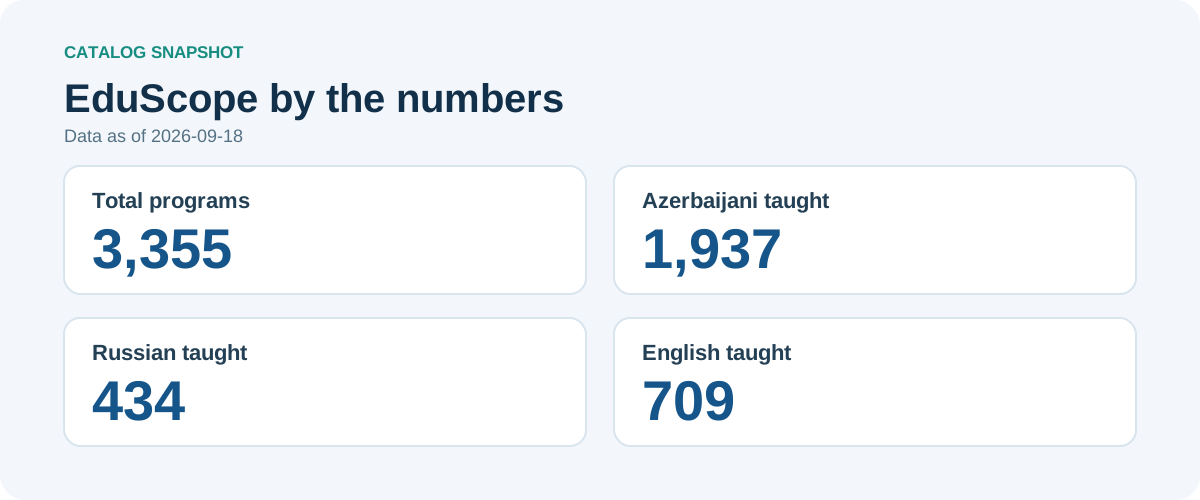
- Total programs in the current catalog snapshot: 3,355
- Azerbaijani-taught programs: 1,937
- Russian-taught programs: 434
- English-taught programs: 709